

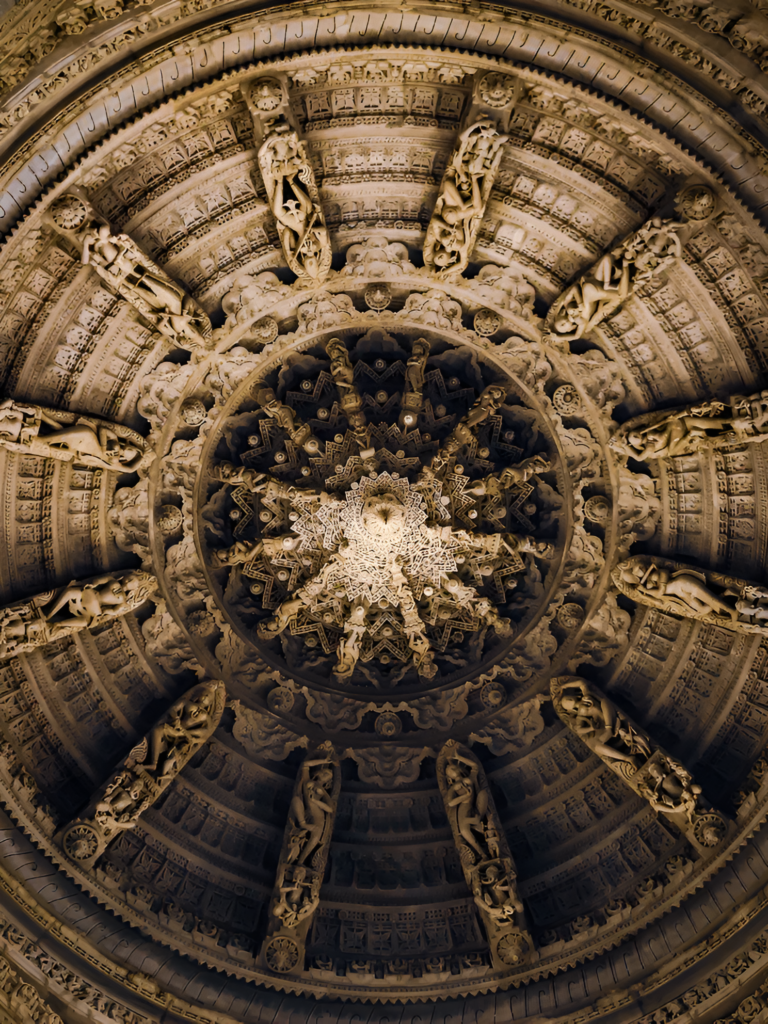
They use their hands like maestros, wielding chisels and tools. With unwavering patience, they transform rough slabs of stone into intricate designs and their work brings out the very essence of the marble they work on.
They are the Ustaji–the artists who are the natural custodians of the exquisite designs on our marble temples. And, this is the story of how these master craftsmen breathe life into the revered Makrana marble through three prized techniques: Jaali, Carving and Inlay.
The Art of ‘Jaali’ in Marble Temples
The Origin Story
Ancient Indian sanctuaries dedicated to Buddhism, Jainism, and Hinduism, were usually dimly lit and enclosed. These early temples used ‘Jaali’ (derived from the Persian word ‘net’) to control lighting and create an atmosphere conducive to worship.
With the advent of Islamic architecture in Gujarat, jaalis (or perforated stones and latticed screens) found prominence in mosques and tombs, embodying the symbolic significance of light in Islam. Over time, this architectural embellishment started incorporating geometric and naturalistic patterns too.
In fact, Architect Yatin Pandya points out that its increasing popularity came from its dual functionality – as a facilitator of light and structural strength. The holes, often comparable to or smaller than the stone’s thickness, add to the jaali’s visual appeal.
The Ustajis of Makrana have perfected the art of making Jaalis over time and know exactly how to craft this delicate dance of light and stone.
From Monuments To Mandirs: Where Is ‘Jaali’ Found?
The Mughal gardens, synonymous with paradisiacal beauty, often featured Jaali screens, transforming garden spaces into ethereal realms where light filtered through delicate patterns.
For instance, Fatehpur Sikri showcases intricate Jaali screens adorning structures like the Jama Masjid and the Salim Chishti Tomb.
While the evolution of the Jaali design did take a significant leap forward in the Mughal era, its journey is not confined to a single narrative; it is a kaleidoscope of regional variations, each reflecting the unique cultural ethos of its surroundings.
In Gujarat’s stepwells, such as Adalaj and Rani ki Vav, mesmerising trellis-like jaali patterns serve both decorative and functional purposes.
In the southern states of India, temples like the Meenakshi Amman Temple in Madurai showcase stone-carved screens with delicate latticework, adding a sublime layer to Dravidian architecture.
In contemporary temple architecture, Jaalis continue to find their place – The Lotus Temple in Delhi features a grand jaali-like structure made of white marble petals, allowing natural light to filter through. The Akshardham Temple in Gandhinagar too embraces traditional jaali motifs in its intricately carved marble facades.
How Do The Ustaji Make Intricate Jaali Patterns?
- They first transfer the chosen design onto the surface of the Makrana marble block. Ustajis may use a variety of tools for this, such as pencils, chalk, or even temporary markers. The precision of this step is vital and it goes on to become a guide for the carving process
- They then begin carving with the use of specialised tools such as chisels and mallets. Carefully carving along the marked lines, they remove excess marble to create the openwork pattern characteristic to jaali designs.
- After this is done, Ustajis focus on detailing and refining the design. They use smaller tools to add intricate details, smooth out rough edges, and ensure that the pattern is consistent and aesthetic.
- Since jaali designs are not just decorative but also serve structural functions, Ustajis pay attention to the thickness and strength of the remaining marble. The holes and patterns must not compromise the structural integrity of the marble slab.
- Once the carving is finalised, the entire surface of the marble is polished to make it smooth and lustrous.
The Art of Carving or Gadhai in Marble Temples
Since time immemorial, artists have used carving, a foundational technique, to shape marble into intricate reliefs and decorative motifs. Temples, in fact, have long featured depictions of deities, mythological scenes, and floral patterns.
Mythological Depictions: Marble carving often involves sculpting deities and mythological figures on slabs, narrating stories from Hindu epics. These intricate carvings adorn temple walls, pillars, and sanctums, bringing the divine narratives to life.
Floral and Geometric Patterns: Carved floral and geometric patterns add an ornate touch to temple architecture. These designs, often seen in friezes, doorways, and ceilings, contribute to the aesthetic appeal of the temple and showcase the artisan’s mastery over the medium.
Inlay Work (Parchin Kari): Marble carving extends beyond standalone sculptures to include inlay work and ornamental flourishes. Artisans delicately carve out spaces in the marble to embed precious and semi-precious stones, creating a mosaic of colors that catches the light in mesmerising patterns. This is indeed marvelous and we delve into this in detail, shortly after.
From Monuments To Mandirs: Where is Carving Found?
In Rajasthan’s Birla Mandir, marble carvings tell the tale of devotion and royalty. A testament to the opulence of Rajasthani Gadhai, these temples showcase intricate carvings on marble pillars, ceilings, and doorways.
In the southern states, especially Karnataka, the art of marble carving takes on a different hue. The Shri Shantinath Jain Temple is Mysore showcases the grandeur of Vishwakarma architecture, with pillars adorned in mesmerizing carvings that narrate episodes from Hindu mythology. The intricate details reflect the rich cultural heritage of the region.
More recently, the garbha griha of the Ram temple in Ayodhya features intricate carvings on marble sourced from Makrana.
How Is Carving Done by Ustajis?
- The surface of the Makrana Marble block is first levelled to make it even for the intricate work ahead.
- The Utsajis then transfer the design onto the marble surface using tracing paper and carbon paper.
- The rough carving phase involves removing excess material from the marble block to create a barebones form based on the design. Stonecrafters use larger tools such as mallets and chisels to carve away the bulk of the unwanted stone, gradually revealing the rough shape of the intended sculpture.
- With the rough form established, Ustajis transition to finer tools for detailed carving. Small chisels, rasps, and other precision instruments are employed to refine the contours, add intricate details, and bring out the nuances of the design. This phase requires a high level of skill and patience.
The Art of Inlay or ‘Parchin Kari’ in Marble Temples
ORIGIN STORY
While the Taj Mahal might be the most prominent example of this technique, its roots go way back to ancient Rome, where it was called opus sectile. By the 4th century CE, inlay had become an integral element of statues and carvings within churches and church facades.
The art of inlay experienced a revival in Renaissance-era Italy during the 15th century CE, evolving into what came to be later known as pietra dura. Here, it became increasingly popular as paintings in stone.
The Italian craftsmen, true masters of their art, introduced the world to an exquisite form that transcended its humble origins. Pietra Dura adorned various elements, from decorative panels to intricately hand-carved motifs, and eventually found its way to the Mughal courts in India. The art of marble inlay became synonymous with royalty and gradually took over – from the mosques in Delhi and Agra to the palaces in Rajasthan.
‘On Each Stone a Hundred Colours’: Where Is Inlay Work Found?
The Taj Mahal stands as a testament to the seamless fusion of Mughal artistry and the Italian Pietra Dura form of inlay work. The cenotaphs of the Emperor and his wife, the main floor, and the surrounding marble railings resonate with the resplendent charm of this intricate art form.
In her book The Taj Mahal: Architecture, Symbolism, and Urban Significance (2005), architecture and art historian Ebba Koch recounts the 17th-century Persian poet Abu Talib Kalim’s description of the parchin kari on the Taj:
“On each stone a hundred colors, paintings, and ornaments Have become apparent through the chisel’s blade. The chisel has become the pen of Mani, Painting so many pictures upon the translucent marble… Pictures become manifest from every stone; In its mirror behold the image of a flower garden. They have inlaid flowers of stone in the marble; What they lack in smell they make up with color. Those red and yellow flowers that dispel the heart’s grief, Are completely out of carnelian and amber… When of such stones the surface of a tomb is made, The deceased will want to clasp the flower pictures to her heart.”
The style fully developed with its integration into the Taj Mahal and was then adopted across forts and mosques built in the region.
Art historian and writer William Dalrymple, in his book City of Djinns: A Year in Delhi (1993), describes the evocative beauty of Old Delhi’s majestic Mughal architectural remains: “As you sit on your rickshaw and head on into the labyrinth you still half-expect to find its shops full of jasper and sardonyx for the Mughal builders, mother-of-pearl inlay for the pietra dura craftsmen.”
Besides the Taj, The Jagmandir Palace at Udaipur, built by the Sisodia rulers of Mewar, incorporates parchin kari. Gul Mahal, built by the then Mewar king Maharana Karan Singh, features massive marble slabs in its interior walls inlaid with rubies, jade, onyx, jasper, and carnelian.
If this structure appears fit for a prince, it’s because it was designed especially for a young Shah Jahan, then known as Prince Khurram, seeking safety there as a refugee while rebelling against his father Emperor Jahangir to inherit the Mughal throne.
How Is Parchin Kari Done by Ustajis?
- The journey of marble inlay unfolds with the meticulous etching of a predefined pattern, whether it is enchanting florals or mesmerizing geometrical designs, onto the marble slab.
- The artistry continues with the cutting of small marble pieces in varying shades, each delicately shaped to fit precisely into the engraved grooves. Beyond marble, the inlay spaces welcome the embrace of diverse materials, creating a tapestry of colors and textures.
- The Ustaji, the orchestrator of inlay work, begin by creating a design on a brass sheet, serving as the blueprint for the masterpiece. This design is then meticulously traced onto the marble, carved to perfection by skilled artisans.
- Slices of colored stones, both precious and semi-precious, find their places in a harmonious mosaic. Heat treatments, an alchemical process, enhance the natural beauty of the stones, adding a nuanced touch.
- The realm of natural stones embraced by the Ustaji for inlay work is diverse and awe-inspiring. From the purity of White Jasper to the regality of Tiger Stone, each piece contributes to the symphony. As the inlay work reaches its crescendo, the final act involves the careful polishing of the surface and edges. The stone bar, wielded with mastery, imparts a lasting shine, ensuring the endurance of the artistry for decades.
As the inlay work dries and the final polish is applied, the masterpiece is unveiled—a testament to the dedication and skill of the Ustajis of Makrana.
- Their hands, guided by tradition and steeped in reverence for the craft, breathe life into the timeless art of marble inlay, leaving an indelible mark on the architectural wonders gracing the Indian landscape. The Taj Mahal stands not merely as a monument of love but as a canvas where theUstaji’s artistry and Makrana’s marble weave an eternal tapestry of beauty and craftsmanship.
Their rituals of craftsmanship echo the rituals of worship, which are themselves an art form perfected over thousands of years. Through dedication, an oasis of tranquility spreads through the mandir, the home, and the wider world.
‘Gold Work’ in Marble Temples
Often gold leaves, foils or strips are used to embellish and highlight specific elements on marble surfaces. This decorative technique involves applying thin layers of gold onto the marble to create patterns, designs, or accents. Unlike usual designs that use gold paint, Shwet uses real gold strips on its designs to add more grace.
Prominent Examples
Gold work adds a luxurious and ornate quality to marble structures, enhancing their visual appeal and cultural significance. In the Sheesh Mahal in Jaipur, goldwork has been incorporated into the intricate designs, creating a dazzling effect.
The Mysore Palace, a magnificent example of Indo-Saracenic architecture, incorporates intricate gold work on its doors, ceilings, and pillars. The use of gold enhances the overall grandeur of this royal palace.
How do Ustajis do this?
1. They begin by placing the slab or piece horizontally, resembling a table, on a flat surface before the assembly process.
2. Then, they initiate the base work by applying a yellow color base using a brush.
3. Manual gold leafing is done to ensure color coordination and prevent the gold on the white background from appearing faded, maintaining a consistent tone.
4. Finally, they apply a finishing touch using Fevicryl golden color with a brush. The focus usually is done on the edges and miscellaneous areas that may not be perfect yet.
5. They conduct a final round of manual gold leafing on any new patches of paint.
6. They complete the process with a final coating to protect the gold from exposure and enhance longevity. This can be achieved by using lacquer (applied with a gun) or a combination of varnish and thinner, which can be applied without a gun
Ustajis At The Heart of What We Do
The Ustaji – also described as the masters of light – are amongst the most talented in the world and central to what we do at Shwet. They understand that God is in the details and bring it out in every temple we build. Their delicate skill draws out the marble’s ethereal sheen, bringing divine grace into the home. They seek perfection in every task they carry out, discreet in their workings, yet bold in honoring the wisdom of ages.
In addition to their own knowledge, which is gained from countless hours working on the stone, they also have the knowledge of their ancestors who have gone before them and have handed down this knowledge to them as a most precious inheritance. The Ustaji remain the masters of Makrana, and our go-to at Shwet. Their work has inspired the work of many artists and sculptors who come to the stone in search of the perfect medium and continues to be our one true legacy.